
Cameron Winter, wild goose

The 23-year-old Brooklynite is being lauded as one of today’s greatest songwriters. During a promo trip for Getting Killed, the red-hot new album from his band Geese, Winter explains his aversion to hype, and his complex connection with the rock canon.
Music
Words: Henry Bruce-Jones
Photography: Will Wright
“So much has changed in two years,” Cameron Winter declares from the sweat-flecked stage of The George Tavern. Addressing a thronging room, which hums with beer and restless anticipation, he levels: “We’ve grown up so much, and you have too.”
He’s not wrong. His band, Geese, formed during high school in 2016. But the Brooklyn four-piece have recently gone from buzzed-about Park Slope wunderkinds to being hailed as “Gen Z’s first great American rock band” and getting a Cillian Murphy co-sign. The foundations for this Adderall rapid rise were in no small part laid out at the end of 2024, when Winter quietly released his solo debut, Heavy Metal, to rapturous reviews and an audience unprepared for quite how deeply they would fall in love with him. Scrub quickly through countless sold-out shows, appearances on Jimmy Kimmel and Jools Holland and tens of thousands of breathless words published by Rolling Stone, The New York Times and GQ, and you arrive, squeezed in beside members of every upcoming band in London, at indie rock institution The George Tavern – the go-to venue for a big band to blow away a small room. Just as I notice Lewis Capaldi leaning against the bar on the opposite side of the room, Geese tear viciously into the first songs from their latest album, Getting Killed.
From the very first minute of Getting Killed, you can hear just how far Geese have come. The band’s third studio album signals such an explosive doubling down of focus, energy and flair that it’s no wonder it opens with Winter and JPEGMAFIA screaming in unison: “There’s a bomb in my car!” It’s also an album that seemingly emerged, fully formed, out of the head of Heavy Metal. If that album was Cameron Winter’s own personal headache, then Getting Killed is the band’s rock ‘n’ roll trepanation. Winter meets Emily Green’s luminous guitar, Dom DiGesu’s lithe bass and Max Bassin’s driving percussion with a baritone austere enough to go to war with any instrument. The result is blunt force delivered with a lethal point, laced with enough invective, wit and adulation to make anyone with ears sit up and listen.


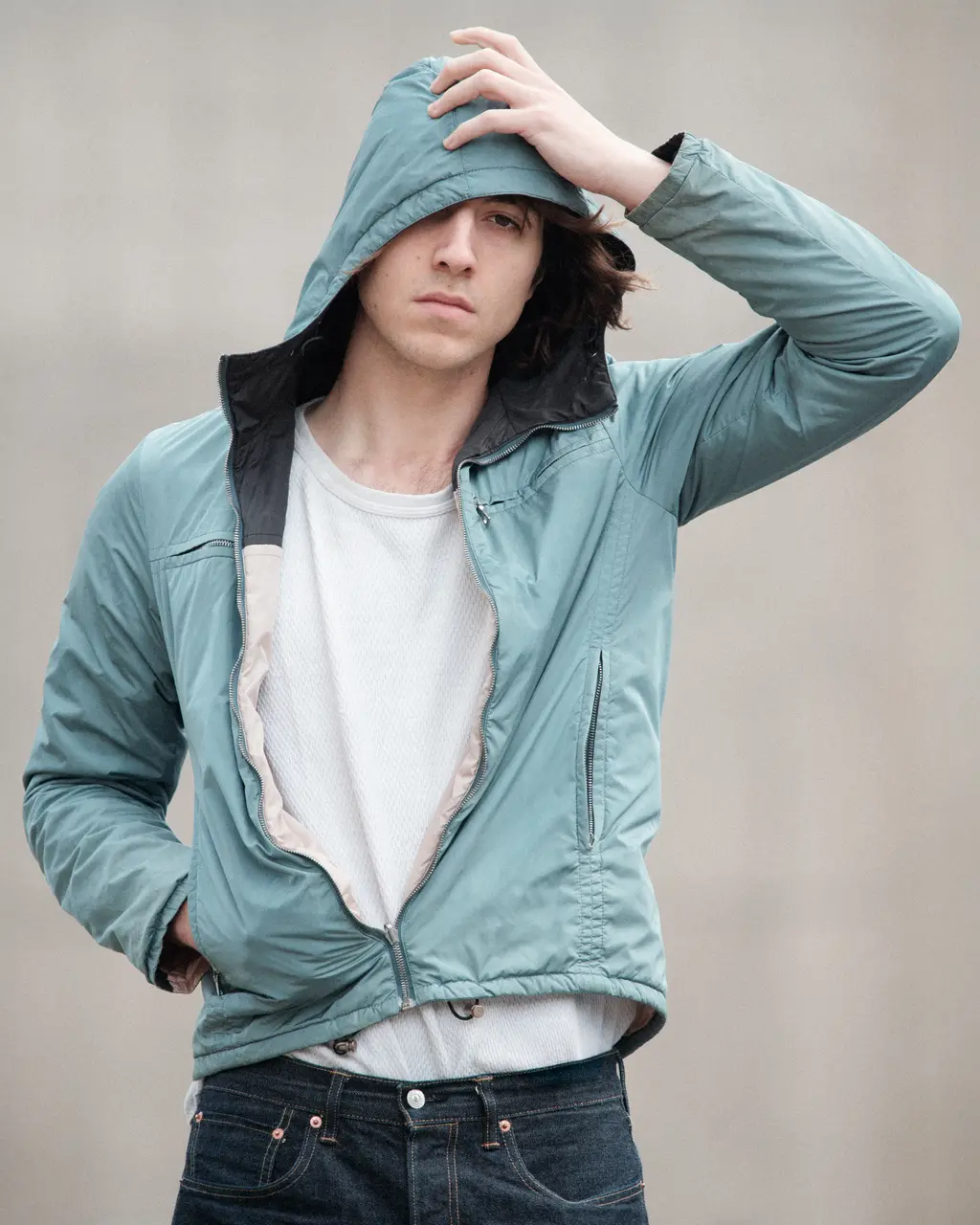

The day after the intimate unveiling of Getting Killed at The George Tavern, while appreciative of the crowd’s reception – positive, verging on feverish – Cameron Winter remains remarkably nonplussed. I will discover that he’s allergic to anything approaching laurel-resting, wielding skepticism like an air rifle. “The buzz stuff, it comes and goes,” he deflects, sipping slow from an iced coffee. He’s sitting across from me at a long table, bisecting a glass-walled meeting room in the London office of his label, Partisan Records. “Soon, we’re going to have put out enough material that we stop being so mysterious. We’re gonna drop some stinkers and then it will all get flushed away.”
Winter is cautious of how transient the noise around a work of art is, how it’s inversely proportional to its potential staying power. “It really ruins it when you talk about anything,” he says. “I cringe whenever I say anything about my music, it feels gratuitous.” If you spend enough time with Winter’s music, you might understand where he’s coming from. The heart-in-throat folk and lonely soul of Heavy Metal and the omnivorous experimental rock of Getting Killed have been distilled from recording sessions so stuffed with ideas the songs sound as though they’re constantly on the verge of bursting.
Winter’s writing is dense with allusion, from Hellenic odes like Heavy Metal’s Nausicäa (Love Will Be Revealed) and Getting Killed’s Sisyphean Husbands, to the cocksure pantomime of American imperialism on 100 Horses and Au Pays du Cocaine. One of his trademarks is the deftness of his rock references. On Heavy Metal’s The Rolling Stones, he nods to the keening Midwest emo of Tigers Jaw, folding a fragment of their soul-bearing refrain, “But my emotions ran unopposed /I felt just like Brian Jones,” into his tumbling folk dedication to trying and failing to write the perfect song. At times it’s both sillier and more subtle. Try singing, “I came up here to sleep in your infamous kitchen,” from Cancer of the Skull in your best Bob Dylan voice. Now, think of Dylan as you hear Winter sing the line, “Songs are meant for bad singers.”
“A lot of stuff I make starts too derivative and then I just cringe at it listening back, so I have to find a different way until I stop cringing. The question is always: how much allusion can I tolerate?”
Winter closes Getting Killed by calling out to Buddy Holly, Don McLean and folk legend Pete Seger on the epic Long Island City Here I Come, while the rest of Geese furiously careen through a crumbling wall of sound. “It’s a human thing to copy other people,” he says. “It’s how you learn to speak, it’s how you learn to walk, you copy, so when people don’t copy at all it feels like a rejection of the fact that they’re just flesh and blood.” Winter is no exception. “A lot of stuff I make starts too derivative and then I just cringe at it listening back, so I have to find a different way until I stop cringing,” he levels. “The question is always: how much allusion can I tolerate?’
Winter is aware of the pitfalls of wanting to sound like the greats. Though it’s hard not to hear Van Morrison’s 1968 classic Astral Weeks in Heavy Metal, he deflects the comparison. “In about 40 years I’ll have my anti-vax magnum opus, a triple album about government overreach will be hitting the shelves,” he quips, referencing Morrison’s spate of lockdown protest songs in 2020. “It would be funny if I really sped through my recording career like that, being the grumpy old man on stage right now,” he adds, grinning.
In the fury and the frailty of Winter’s songs, both solo and with Geese, there is the tacit understanding that “A masterpiece belongs to the dead,” as he ventriloquises Buddy Holly’s ghost singing on Long Island City Here I Come. This might be why his music is full of martyrs, from Brian Jones to Joan of Arc. Rather than get bogged down in where his sound might have come from, he is content to cut down his forebears and ride toward the rising sun. “Sometimes we fall into this thinking where we just want to be like them,” he admits. “Sometimes you stumble upon a different mindset, where you find yourself with something you actually want to say and do.
“There’s a certain inspiration that’s aesthetic, like a trick that you want to steal,” Winter says of his approach to composition. “But then there’s another kind of inspiration, something that you hear that’s so good and so honest, there is no trick to steal.” His lyrics often position this inspiration as the product of intense exertion. Things are always being flattened in Cameron Winter songs, whether it’s his pounded masterpiece in Heavy Metal’s The Rolling Stones, the moon in Love Takes Miles, or birds against “clean glass” in Try As I May. The effort is also present in all the walking, dancing and exhausted feet of Winter’s subjects. On Heavy Metal, Nausicäa is “walking really slow,” while Winter is left with the promise of shoes in Love Takes Miles, before walking and walking in Can’t Keep Anything. On Getting Killed, he offers to wash a lover’s feet while requesting to dance away forever with Cobra, hikes up a hundred hills in Husbands and eventually heads out “with no shoes on” on the album’s title track.
To make a great song, he says, “it has to grab ya, without you grabbing it. It has to be mutual and most of the time it’s not.” When it’s not, Winter is quick to rebuke his more perfectionist tendencies, confessing, “I tweak more than I record” on a Reddit AMA the day of Heavy Metal’s release. “Being perfectionist is dishonest, in a way,” he says. “Your ass ain’t perfect! I like music that doesn’t have its guard up all the time.” On that subject, Winter praises New York rap experimentalist Xaviersobased (“there’s very few people who are really just saying fuck the rules as much as he is”) and London’s fakemink (“he can really run with it”), citing their perfectly fried production and prolific release schedules as something to strive for. “They’ve got the right idea,” he smiles. “I want that to be Geese and me eventually, to break free of the freaking album cycles and just put it out the moment it’s done. To pick a thing off your camera roll and kick it out there.”
That being said, Winter remains rigorous, mindful of the pursuit of innovation over substance. “Complete and total, deliberate originality is not all it’s cracked up to be,” he reasons. “Originality by itself is not so great, there’s an infinite amount of stuff to be original about.” In the world of Cameron Winter, originality is privileged less than epiphany, with the subjects of Heavy Metal drifting between stasis and sudden realisation. “Epiphanies are fun,” he says with a smirk. “They’re a blast, I try to have at least one month to keep the doctor away.” If that’s true, Heavy Metal contains enough of them to last Winter a whole year. In every single song, the artist is either being dragged or lurching forward into the light. “I am blind and you are ugly /It’s so easy to want you,” he warbles on Nausicäa, his gnarled love finally revealed. The heart-rending Drinking Age captures the moment at which a blubbering drunk catches a harrowing glimpse of the rest of his life: “Today I met who I’m gonna be from now on /And he’s a piece of shit.”
“People will say things that they got out of my songs that I never considered possible”
On $0, a petulant and perfect piano blues lament is interrupted by the goosebump-inducing presence of the Holy Spirit. When Cameron Winter cries: “God is real, God is real /I’m not kidding God is actually real /I’m not kidding this time,” it sounds as ecstatic as any trance arpeggio. This is epiphany as a drug-induced high, a sudden rush of clarity that saturates the colours around you and makes the world gleam as though lit by a million candles. $0 channels a religious intensity that clearly delights Winter, who opted to call his first solo tour the “God Is Real” tour and schedule many of its dates in churches, yet it’s something he is quick to curb. “I don’t think you need to get into that aspect, even understand it, to get the message and to get a kick out of the songs,” he says.
Nevertheless, Winter spends an awful lot of time on Getting Killed getting pretty biblical. Bow Down sees him conversing with an angel berating his inexperience with prayer. “I was in love, and now I’m in hell /With Maria’s dead bones talking to myself,” he caterwauls, profaning the virgin Mary into a rock ‘n’ roll relic before unleashing a catty observation only a Bible nerd could have: “I’ve met angels so deep undercover /That they’d sit on Solomon’s throne.” On the anthemic Taxes, Winter is once again wilting from the heat of hell’s flames, fanned by self-loathing and his tax return. “I should burn in hell /But I don’t deserve this,” he groans, calling for his own crucifixion: “If you want me to pay my taxes /You’d better come over with a crucifix /You’re gonna have to nail me down.”
By the time the album comes to a skidding halt on Long Island City Here I Come, Winter is trying to convince Joan of Arc she can listen to somebody other than God (namely, Winter himself), describing crowds gathered at church as “my concubines and my enemies” and is being rebuked by Mary to stop adding more cowbell with his gun.




Yet, despite all of his valiant attempts, Winter is not yet convinced anyone has successfully written a song about God. “Better people than me have tried, like actual composers. They work for years and then they’re like: this is my song for God, here it is, just for you – then a fucking anvil falls on their head. Try again!” His gaze strays through the glass of the meeting room to an office wall where, alongside the rest of Partisan Record’s catalogue, the Heavy Metal vinyl is displayed. “If a song was successfully written about God we wouldn’t need to make ‘em anymore… Same thing with love songs, if someone had really summed it all up, there wouldn’t be much more to say. You might think Neil Young got it right 50 years ago, but then NLE Choppa has got more to add to the story.”
Winter has been compared to plenty of artists like this, including Van Morrison, Harry Nillson, Tom Waits, but the musician I hear reverberating in his songs is the American primitive guitarist and folk musician Robbie Basho. He too was blessed with a singular, soaring voice. He too was dedicated in his search for the spirit in the sound without conforming to any particular creed. He too was able to take the everyday experience of being an American man and enchant it into something more transcendent; in Basho’s case, winding ragas influenced by Indian classical music.
Though reliably wary, Winter seems pleased by the comparison. “People will say things that they got out of my songs that I never considered possible,” he says. That’s most likely because when you hear Winter winding beat poetry around hymns and folk songs, buoyed by the virtuosic playing of a band barely in their twenties, the feelings that normally stay in your gut are drawn up sharply into your chest. “I’m realising that’s where a lot of the universal probably lies, getting real deep on specific feelings,” he says. “By getting to the bottom of those, you get to the bottom of a lot of others, too.”

