
Tracey Emin: “I’ve lived my life for art”
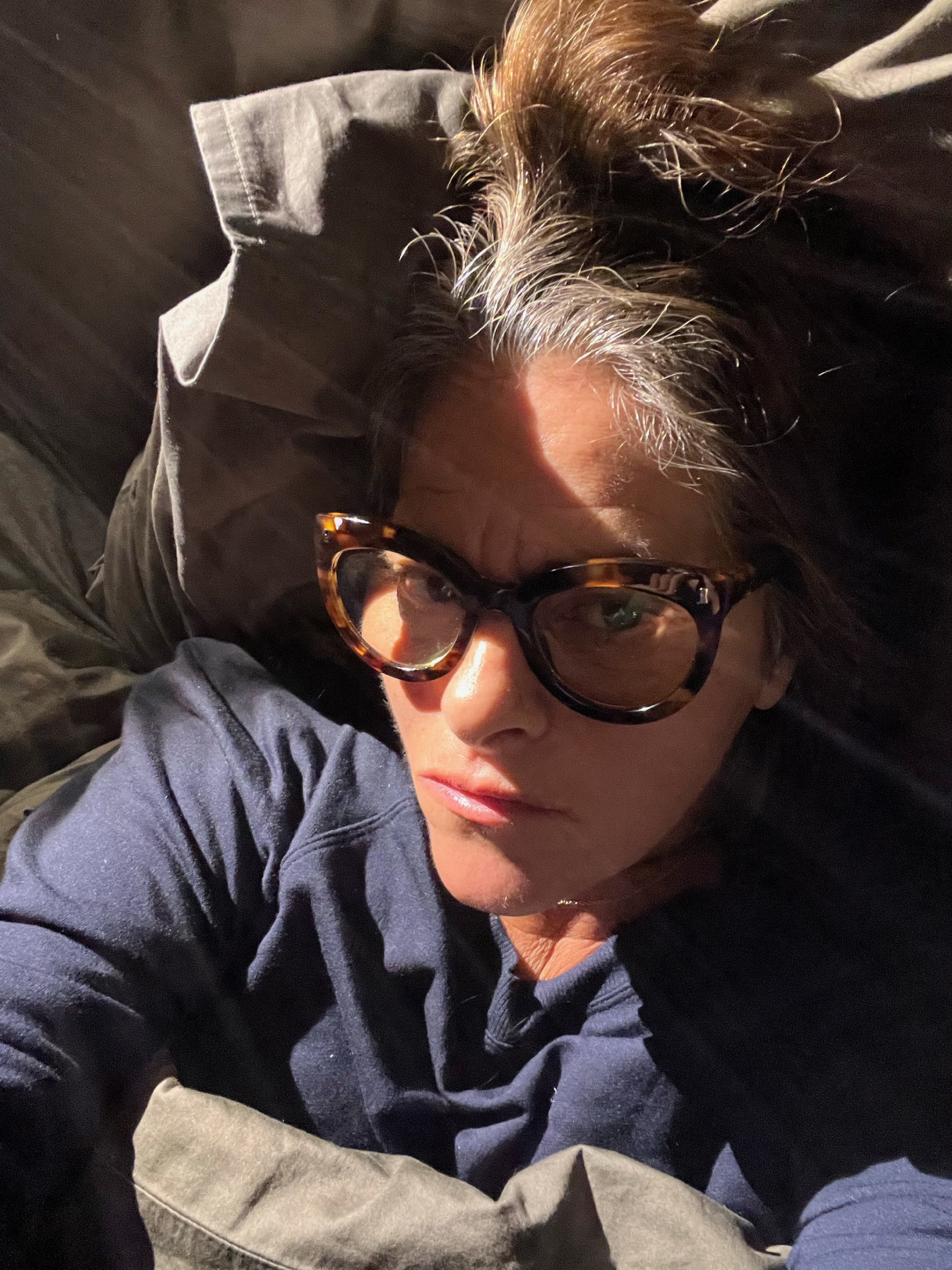
She lives in chronic pain, doesn’t have a bladder and survived cancer. Despite all of this, the artist has managed to pull together her biggest exhibition yet, Tracey Emin: A Second Life , at Tate Modern. What’s your excuse?
Culture
Interview: Joe Bobowicz
Taken from the spring 26 issue of THE FACE. Get your copy here.
Hey Tracey. How are you doing today?
I’m confused about today because I just came back from New York, then came straight to hospital for various tests. And I’m still in the hospital. I feel like I haven’t landed from New York – like I’m in no man’s land. The view out my window is the London skyline. I can see quite dramatic, recognisable buildings. I feel like I’ve been asleep and woken up in a different bed and city.
I hope you’re doing OK, considering. Congratulations on A Second Life. As well as new artworks, you’re also showing ones that made you a star, including your sculpture My Bed (1998) and the short film Why I Never Became a Dancer (1995). What is the significance of putting them together?
The title says it all: the second life. Those [older] works are my first life, and my new works are my second life. I think that My Bed and my older works are as relevant today as they were when I made them. They might even be more relevant. People never took what I was making work about seriously then. Because times and people have changed – there’s more respect for women’s views and issues – I think people look at my old work differently.
Your body has always been integral to your art throughout the years, addressing sexual violence, abortion and, more recently, the physical reality of living with a stoma bag. Have you ever found it tricky to be so honest about your physicality?
l’ll tell you what: it is tricky if you don’t tell the truth. I actually had a urostomy. I don’t have a bladder, which is really complicated and quite difficult on a day-to-day level. If I wasn’t open about it, I’d be finding myself in a lot of difficulties and would have to lie constantly to the people around me. I’d behave in a very evasive way, which isn’t my nature. I like to make my life as simple as possible so I can focus on my art.
What words of advice would you give to other artists managing a disability?
Last night, I watched a documentary on Yinka Shonibare. I really like Yinka. I respect him and his work. I was shocked to realise that he wasn’t born with his condition. Aged 18, he had a virus in his spine, collapsed and woke up two weeks later paralysed [Yinka has used a wheelchair since then]. Yinka manages to make work and be focused. He’s got a brilliant sense of humour, and he made it work for him. When you think about Yinka’s disability and what happened to him compared to mine, he’s a fantastic role model. I think that by using your disability and acknowledging it, not working against it, you can go forward.
You’re five years sober and decades smoke-free. How do you unwind without your vices?
I have my cats, Teacup and Pancake, and they are the most loving, soothing, sweet, cuddly, affectionate, furry little munchkins. They make me totally relaxed when I’m with them. I think pouring love into some- thing or someone is an excellent way to relax, because you lose yourself.
You’re also five years cancer-free. How did your view on life change after your experience?
I’m grateful for every single day. What I don’t like is that I constantly have infections and setbacks. I find it hard to make plans and come across as quite flaky, because I appear not to turn up or change things at the last moment. And I have massive bodily function problems, so being social is difficult. That’s a big change. But there are lots of things I don’t care about anymore that I used to care about, and many more things I do care about that I wasn’t aware of. My perspective on life is different.
“One thing I learned [at the Royal College of Art] was the kind of artist I didn’t want to be”
Also showing at the Tate is the appliqué blanket artwork Mad Tracey from Margate. Everyone’s Been There (1997), an unvarnished look inside the mind of a young Tracey. Has part of living your second life meant re-embracing Margate, the hometown you fled?
I’ve done more than embrace it. I live there, and I love it. It makes me really happy. I can’t believe that with my second life comes my old home. And Margate is living a second life. It reinvented itself.
You hated your time studying at the Royal College of Art, as you revealed in the written artwork Tracey Emin C.V. (1995). Nowadays, you run a studio-based art school in Margate, the Tracey Emin Foundation. How does your teaching approach differ from your tutors at the RCA?
I didn’t hate my time at the Royal College of Art, I just found it hard. I felt like I didn’t fit in. I didn’t paint, and I was studying painting. Everything was a struggle. I had no money. The class system came and slapped me around the face, and I really felt it. One thing I learned was the kind of artist I didn’t want to be. I loved some of my tutors there; I worked well with them. The best thing: I learnt to paint. I learnt something. Now, my philosophy is that if you’re being taught, you should learn.
There are still barriers to arts education for working-class people. Does this affect how you approached such a major exhibition?
Not really. You see it through the work. You see that I come from a mixed race and totally impoverished background [Tracey’s mum was Romani, her dad Turkish-Cypriot]. It’s obvious. But back to education. I tell people who come from poorer backgrounds, do it, because if you’re in a position where you can’t pay it back, you won’t have to. If you don’t go to university, you’re beaten. If you don’t go to university to do what you want to study, then you’re beaten. But there are lots of things people can do that don’t involve university.
You’ve voted Tory twice in your life, in 2010 and 2015, but before that it was always Labour. Who will you be voting for in the next general election?
I’ve [also] voted for the Animal Welfare Party, and I’ve voted for the Women’s [Equality] Party. In the next election, I would like to vote for the Green Party, maybe. My biggest fear, whatever happens, is the extreme far right. I just have to tactically vote to stop [them] getting in.
What’s something you’d like FACE readers to remember?
That I’ve lived my life for art.
What would you tell 13-year-old Tracey if you met her now?
Put the cigarette out and never light it again.

