
What would LA be without palm trees?

No plant species defines the visual identity of Los Angeles quite like the palm tree. But after the January wildfires, and as the city faced a wave of ICE raids this summer, their façade of sanctuary and escapism went up in flames – potentially forever.
Society
Words: Sahir Ahmed
Photography: Jester Bulnes
Taken from the autumn 25 issue of THE FACE. Get your copy here.
The city of La La Land, The Bling Ring and (500) Days of Summer. That Eve Babitz claimed as her playground. That Joan Didion mythologised from her perch in the Hills. The city that, in Less than Zero, Bret Easton Ellis renders as a nihilistic playground for rich white kids, where everyone is conventionally attractive, bored and emotionally devoid. This is the Los Angeles that’s been exported for decades: dreamy, disaffected – and sanitised of the Black, Brown and Indigenous cultures that defined it long before Hollywood started telling its stories.
The cinematic LA of Boyz n the Hood, Mosquita y Mari and Mi Familia tells a different story: tales rooted in generational memory, neighbourhood rituals and the contradictions that colour daily life in the city.
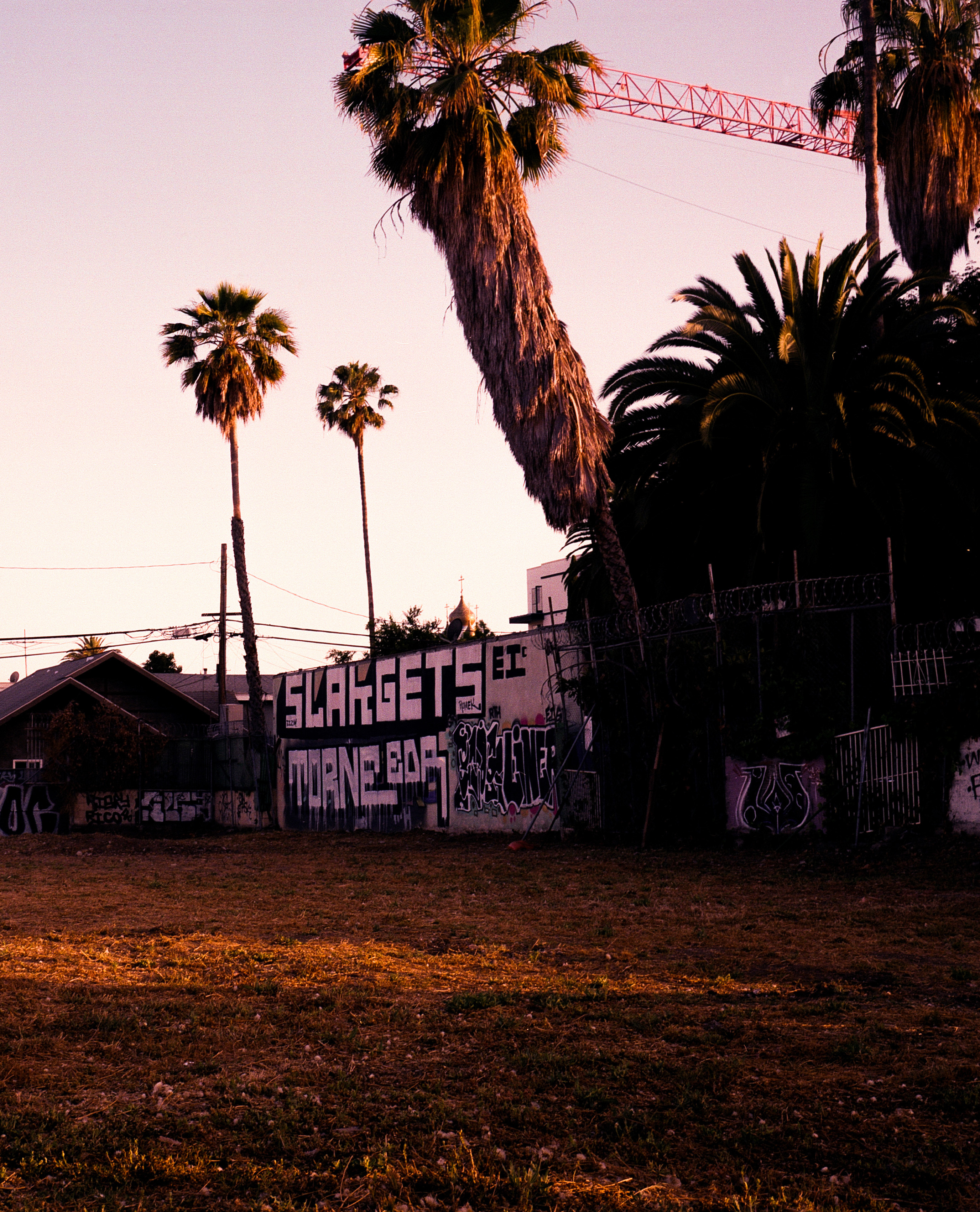
But regardless of the era or aesthetic, what makes these fantasies legible as LA is the landscape. And of the thousands of plant species that shape California’s visual identity, none is more essential to anchoring the illusion than its palm trees. Their silhouettes spike the horizon like exclamation points. Lining streets without shade, they beautify the backdrop but offer no refuge. They don’t belong in Los Angeles, but they tell you where you are.
There is only one palm species native to California – Washingtonia filifera, the fan palm – and it grows not in coastal LA, but in desert oases like Anza-Borrego State Park and the Coachella Valley. The palms that now define the city’s skyline – Washingtonia robusta, the Mexican fan palm – were brought there by Spanish colonisers who invoked biblical paradise to sanctify conquest in the 18th century. In Christian iconography, the palm tree symbolised peace, salvation and eternal life, a convenient emblem for turning territorial expansion into a vision of divine order. But the true explosion came later.
In 1931, as part of a Depression-era beautification push to rebrand LA as a sun-drenched alternative to New York or Chicago, the city planted more than 40,000 palm trees ahead of the 1932 Olympics being held in the city. The Mexican fan palm became central to the city’s image-making. It was “exotic,” “tropical” and timeless. In other words, perfect for Hollywood’s expanding dream factory. And like so much of LA’s image, they were never meant to last.
Now, almost a century on, many of those trees are nearing the end of their lifespan. And they won’t be replanted.
During the Palisades and Eaton fires of early 2025, when the palm trees went up in flames, their burning fronds scattering embers, so too did the illusion they helped to create. Photos circulated of silhouettes ablaze against orange skies, a flaming twist on the very icon that once sold Los Angeles as paradise. In those images, you could see the city’s mythology unravelling. And as the fires burned through more than just dry brush, city officials began openly debating whether to remove the palms altogether. They proposed replacing them with native, drought-resistant species like oaks and sycamores, once planted by the Tongva people on whose land the city sits.

“Now, when the world thinks of Los Angeles, it doesn’t just picture movie sets or red carpets. It remembers fires, raids, helicopters, burning cars. LA is no longer the city of illusion. It’s where the American Dream exposed its seams”
The American West is a place built on aspiration. In its arid hush, everything becomes surface. What the Mexican fan palm obscures is as telling as what it reveals. The fantasy of Los Angeles has always relied on omission: of labour, of lineage, of the people who were here before the palms, and of the people still here after the dream has faded. In his 1990 book City of Quartz: Excavating the Future in Los Angeles, cultural theorist Mike Davis describes LA’s desire to copy the European city, writing: “Evening traffic on Hollywood Boulevard attempts to mimic Parisian boulevard life… but life on the Boulevard is extinct before midnight.” This longing for the “Paris of the Far West” reflects a kind of existential unease, illuminating how LA is troubled by its own identity. Rebecca Solnit, writing in the London Review of Books, put it this way: “To be in California is to be everywhere and nowhere and usually somewhere else.”
This dream of elsewhere, of constantly running towards idealisations, mirrors the palm trees’ role in LA’s mythology. Today, that myth of escape has migrated into new forms: self-driving cars, glassy smarthomes, virtual neighbourhoods pitched as utopia. But it also raises a deeper question: what would Los Angeles be without the people who planted the palms, stitched the garments, cleared the brush and laid the foundations? What would Los Angeles be without the generations of Mexicans and Central Americans who have shaped its rhythms and rituals?
Sergio Arau’s 2004 mockumentary A Day Without a Mexican imagines the fallout if every Mexican in California vanished overnight. Within hours, the state begins to unravel. The satire lands because it’s true: the California Dream was never real without its people. Aldous Huxley’s Brave New World imagined a future where the city lay in ruin, its boulevards scorched and society reduced to ash. The biblical Book of Revelation offers its vision of collapse: cities consumed by fire, the mighty cast down, the merchants wailing for their vanished luxuries.
And in June – as the annual gloom descended on the basin, turning morning skies a leaden grey, the light sinister and perfect – all those fantasies were eroded. On 6th June, a wave of ICE (Immigration and Customs Enforcement) raids swept through Southern California, targeting garment factories and public spaces in broad daylight. Word spread like wildfire across social media. By afternoon, protestors had gathered Downtown. By nightfall, the Edward R. Roybal Federal Building had been defaced. Bottles, bricks and firecrackers flew through the air. Masked agents and police returned fire with rubber bullets and tear gas.
The next day, videos of burning Waymos ricocheted across the internet. The white, sensor-covered driverless tech cars, owned by Google’s parent company Alphabet, have long drawn ire for clogging traffic and harvesting data as they cruise around. When one catches fire, the lithium-ion battery can burn so hot it melts through its own chassis. The footage felt apocalyptic. Protestors blocked the motorways. Sirens echoed through the city. “To restore order”, against the objections of LA’s mayor Karen Bass and the governor of California, Gavin Newsom, President Trump deployed the National Guard and Marines. At a glance, it looked less like LA than a war zone.

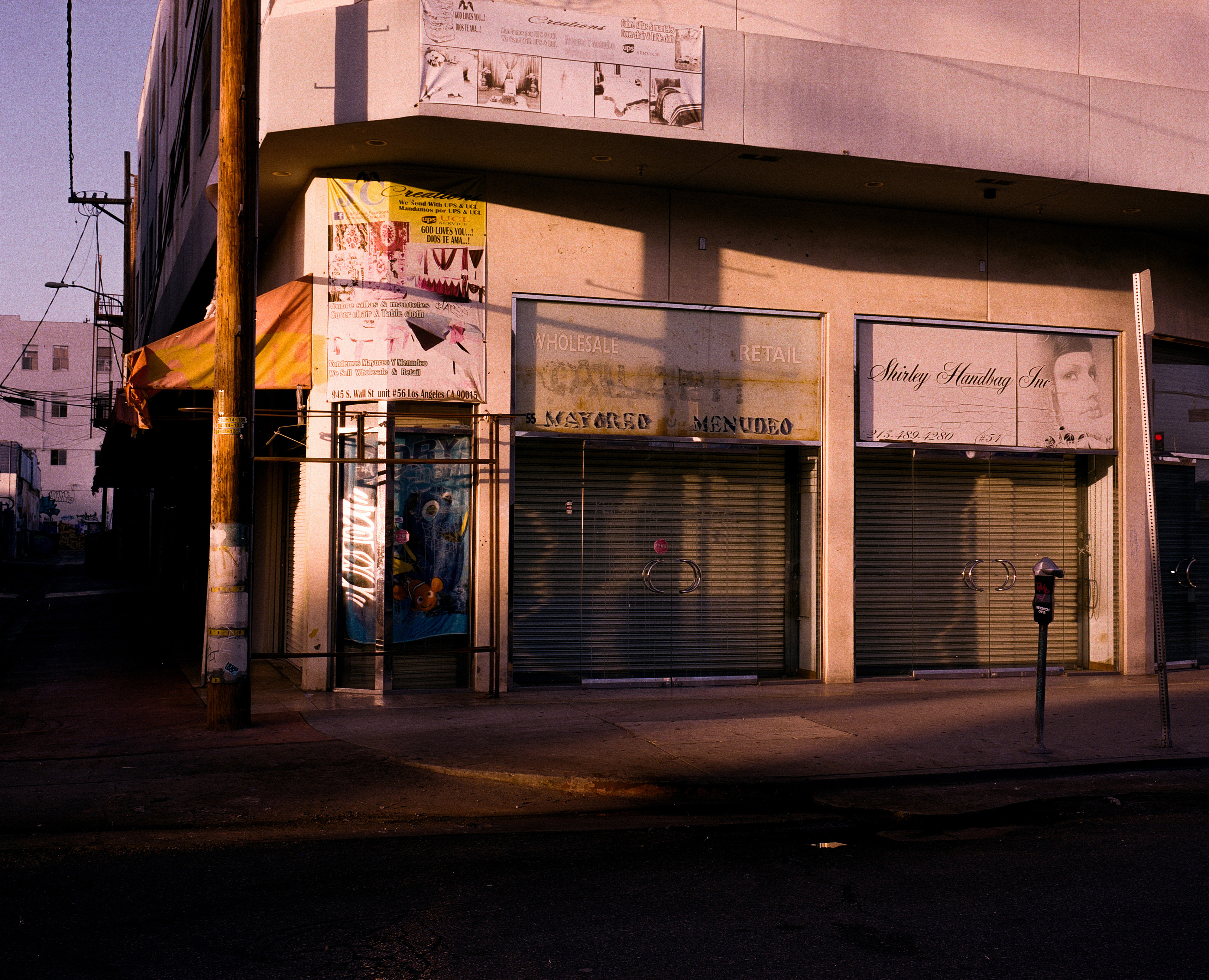
By morning, the fear had spread further than the smoke. Santee Alley, home of outdoor shopping bargains, shuttered its stalls. At the AC Hotel in Pasadena, activists filmed federal vehicles pulling into the parking lot: unmarked SUVs, their occupants wearing tactical vests, holding guns, their faces covered. Protestors gathered outside the hotel’s windows, trying to keep the agents inside awake with chants, pots and pans, bullhorns and mariachi. Within days, the actions had spread to other parts of LA County.
Restaurants couldn’t open. Kitchens were half-staffed or entirely empty. Parents kept their children home from school. Delivery drivers ghosted their apps. In factories and warehouses, machines sat idly. Fear wound underneath the city like a spiral. This, too, was Los Angeles: a city of ghosts who could disappear without warning.
On 14th June, President Trump celebrated his 79th birthday with the U.S. Army’s 250th Anniversary Parade. Across the country and beyond, protests erupted under the banner of #NoKingsDay. Organisers estimated that more than five million people participated in over 2,100 cities and towns in continental America and abroad, from Guam to Puerto Rico, the Virgin Islands to Vancouver. Demonstrations spread to Japan, Mexico and across Europe. But LA – with its crumbling façade of sunny sanctuary and cinematic escapism – captured the collapse most vividly.
What didn’t leave my mind, even weeks later, was that image of the burning Waymos. White husks lit up against the night sky like sacrificial offerings set aflame amid the chaos. The promise of the West, the tech-fuelled dream of convenience and control, melting into the asphalt. It was as if LA had become the site of its own reckoning. You could feel time curling back; the mythology of America itself – a nation marketed as a beacon of freedom and endless possibility – burning up. The very landscapes that once enchanted newcomers and comforted residents had turned hostile. LA was forced to face itself. But beneath the curfews and checkpoints, the curdled fog of tear gas and the aching silence of a city holding its breath, something unshakeable stirred: a sense that before the palms, before Hollywood, a culture, rooted in cycles older and more enduring than any fantasy, already held the city together.
In the days that followed, people compared the June uprisings to other flashpoints in the city’s history: the 1992 riots after the Rodney King verdict, with the police officers who beat him acquitted; the 2006 immigration marches, when students walked out of high schools across East LA waving flags and chanting “Sí, se puede” (“Yes, we can”); the 2020 George Floyd protests, when tanks rolled through Fairfax and a police station burned Downtown. Each time, the city revealed its fractures, and each time it tried to seal them back with images.


People said it felt like the end of the world. But LA has always felt like the end of something. The San Andreas fault, the last stop before the ocean swallows it whole. In Nowhere, Gregg Araki’s characters say LA is like just that: nowhere. Not like anyplace – no place. Which is to say: a city of projection, desire, dislocation. And when that desire turns to dread, there’s nowhere left to run. But the landscape is forgiving. Things that were never meant to take root here do: tamarisk, bougainvillaea, pampas grass, eucalyptus from Australia, jacaranda from Argentina, olive trees from Spain. Palms from Mexico, Chile, the Canary Islands.
You can trace this pattern of arrival and belonging all the way down the coast, from the chaparral of Northern California to the freeway medians of LA. People, too, were brought in, pushed out, made to belong. The Chicana theorist Gloria Anzaldúa described this tension in Borderlands/La Frontera (1987): “Like all people, we perceive the version of reality that our culture communicates. Like others having or living in more than one culture, we get multiple, often opposing messages. The coming together of two self-consistent but habitually incomparable frames of reference causes un choque, a cultural collision.”
Los Angeles is that choque: a city built on fault lines both geological and cultural. It is neighbourhoods formed from border crossings, diasporas and displacements. It’s Highland Park, where the scent of pan dulce from the El Huarache Azteca restaurant mingles with music spilling from the windows of nearby flats, where the daily rhythms were disrupted overnight by raids and rumours of deportation. It’s Boyle Heights, where murals watch over intersections and families have lived for generations, now shadowed by helicopters and unmarked vans. It’s MacArthur Park, where street vendors once lined the streets. Westlake, where the laundrette now sits empty at noon. Huntington Park. Hollywood. Pacoima. Bell Gardens. Compton.
These are more than just neighbourhoods: they are living worlds, they are people. “In Mojave thinking,” as Natalie Diaz writes in Emergence Magazine, “body and land are the same… Unless you know the context of a conversation, you might not know if we are speaking about our body or our land. You might not know which has been injured, which is remembering, which is alive, which was dreamed, which needs care. You might not know we mean both.” If the palms are dying, is the city dying, too? If the people disappear, does the city go with them?
The questions multiply. Now, when the world thinks of LA, it doesn’t just picture movie sets or red carpets. It remembers fires, raids, helicopters, burning cars. Los Angeles is no longer the city of illusion. It’s where the American Dream exposed its seams. Maybe the city was always already burning. After all, the same logic that lined boulevards with palms built the border wall.
And yet, even when the streets empty, the palms wither and the dream burns, something always lingers: a man pushing a raspado cart on scorched pavements; a grandmother watering lemon trees under a sky thick with smoke; the glint of a disco ball in a shuttered storefront. Through the haze, people marching together.

